Body as Instrument: How Biometric Data Is Giving Birth to Bell Tones That Know You
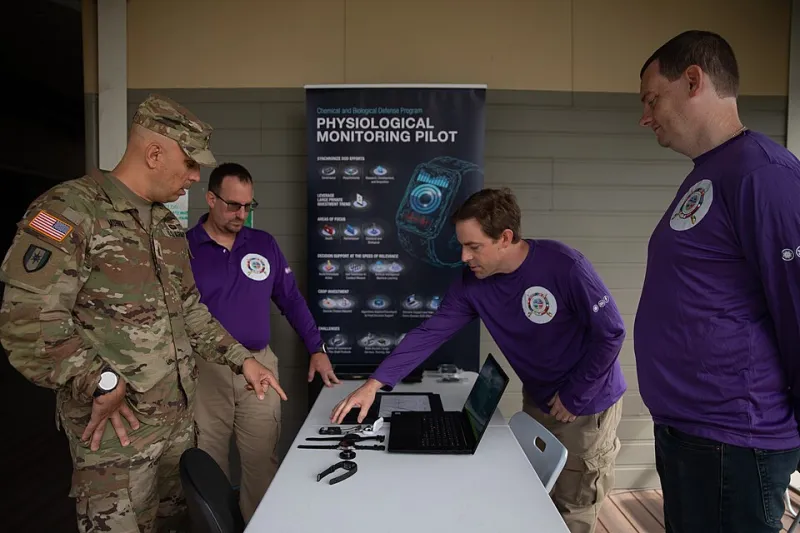
Photo: U.S. Army 1ABCT-1AD by Spc. Charlie Duke, Public domain, via Wikimedia Commons
For most of recorded history, a bell tone was a fixed event. Cast in bronze, struck by a clapper, shaped by the hands of a craftsman who would never know the person listening. The sound traveled outward from its source and arrived at the ear as an immutable fact — indifferent to the listener's emotional state, their cardiovascular rhythm, or the particular tension lodged between their shoulder blades at the moment of impact.
That indifference is now being deliberately dismantled.
At the intersection of biofeedback technology and experimental audio design, a small but rapidly expanding community of composers and sound researchers is building something genuinely new: bell soundscapes that do not merely respond to a listener's presence, but to their interior condition. Heart rate. Respiratory cadence. Galvanic skin response. The invisible physiological signatures that define a human moment are becoming, in these studios, the raw material of tone.
The Signal Beneath the Skin
The concept of biofeedback — using real-time physiological data to influence a system's behavior — is not new to medicine or performance art. Researchers have used it in clinical settings since the 1960s to help patients regulate anxiety, chronic pain, and neurological conditions. What is new is its precision, its portability, and its increasing legibility to creative professionals who are not, by training, engineers.
Consumer-grade wearables have changed the calculus entirely. Devices that once existed only in cardiology wards are now worn on the wrists of millions of Americans, generating continuous streams of biological information. Experimental composers have taken note.
The principle at work is straightforward in concept, if demanding in execution. A composer builds what might be described as a tonal grammar — a set of parameters governing pitch, resonance, decay, and harmonic layering — and then ties the variables within that grammar to incoming biometric signals. When a listener's resting heart rate is low and their breathing slow, the system might generate bell tones with longer decay curves, deeper fundamental frequencies, and wider harmonic spacing. When stress indicators spike, the tonal architecture shifts: shorter attacks, higher partials, compressed intervals. The sound is always the composer's, but its precise expression at any given moment belongs entirely to the person wearing the sensor.
Personalization as Artistic Philosophy
For some practitioners in this space, the biometric dimension is primarily functional — a sophisticated tool for adaptive audio design in wellness applications, corporate environments, or therapeutic contexts. But for a growing cohort of experimental composers, it represents something philosophically weightier: a fundamental rethinking of what authorship means in sound.
Traditional composition operates on an implicit assumption of universality. The composer writes; the audience receives. Even the most avant-garde works in the Western experimental tradition — from John Cage's chance operations to Pauline Oliveros's deep listening practices — ultimately present a fixed or semi-fixed sonic event to a generalized listener. Biometric composition breaks that contract at its root.
When the sound is generated by your body, the question of who authored it becomes genuinely ambiguous. The composer designed the system. But you, in a meaningful sense, played it.
This ambiguity is not a flaw to be resolved. For many practitioners, it is precisely the point. The bell tone, historically among the most socially communal of sounds — calling congregations, marking civic time, signaling collective moments — becomes, in this paradigm, irreducibly private. No two people will ever hear the same piece.
What Neuroscience Brings to the Studio
The collaboration between sound designers and neuroscientists working in this area has become increasingly formal. Research into auditory-physiological coupling — the ways in which specific sonic properties influence and are influenced by autonomic nervous system activity — provides the scientific scaffolding on which these compositions are built.
Particular attention has been paid to the relationship between bell-like tones and what neuroscientists call the orienting response: the involuntary neurological reaction to a novel, non-threatening auditory stimulus. Bell sounds, with their characteristic exponential decay and complex inharmonic partial structures, are unusually effective at triggering this response without inducing alarm. They draw attention without demanding it. This makes them especially well-suited to biometric composition, where the goal is often to create a sound environment that accompanies a physiological state rather than overriding it.
Researchers have also documented the phenomenon of entrainment — the tendency of biological rhythms to synchronize with external periodic stimuli. In biometric bell composition, this creates a feedback loop of unusual sophistication: the body influences the tone, and the tone, in turn, gently influences the body. The system is not linear. It is reciprocal.
Craft in a Data-Driven Medium
It would be a mistake to conclude that biometric composition reduces the composer's role to that of a systems architect. The tonal vocabulary being developed in this space remains deeply craft-dependent. The selection and synthesis of bell sounds — whether drawn from physical modeling of bronze and glass, granular synthesis, or the manipulation of field recordings from actual bells — requires the same sensitivity to timbre, resonance, and harmonic structure that has always defined serious sound design.
What changes is the temporal dimension of that craft. Rather than shaping a fixed composition, the biometric composer is shaping a possibility space: a range of sonic outcomes, each internally coherent, each capable of arising naturally from a particular physiological configuration. The skill lies in designing that space so that every point within it is musically and emotionally meaningful, regardless of where the listener's body happens to take them.
This is, in practice, an extraordinarily demanding compositional problem. The number of variables is high, the interactions between them complex, and the aesthetic standards unforgiving. A bell tone that sounds beautiful in isolation may become jarring when its decay is compressed by a stress-response algorithm. The composer must hear the piece not as a single work but as an entire family of related works, and must ensure that the transitions between states within that family feel organic rather than mechanical.
The Question of Consent and Intimacy
As this practice moves from experimental studios into consumer and therapeutic applications, it raises questions that the field is only beginning to address. Biometric data is among the most sensitive categories of personal information. The physiological signatures that drive these compositions are, in a very real sense, medical data — data that speaks to a person's health, emotional state, and neurological condition in ways that have significant privacy implications.
The most thoughtful practitioners in this space are acutely aware of this dimension. The intimacy that makes biometric composition powerful is inseparable from the vulnerability it requires. To allow a sound system to read your body is to extend a form of trust that the medium has not yet fully earned institutional frameworks to honor.
These are not abstract concerns. As wellness platforms, healthcare providers, and consumer technology companies explore the commercial potential of adaptive audio, the norms governing data use, consent, and transparency in this space will need to develop with some urgency.
A New Contract Between Listener and Sound
What emerges from a survey of this field is a sense that biometric bell composition is not simply a technical novelty but a genuine expansion of what sound can be asked to do. It reframes the listener not as a passive recipient but as a co-author — an unwitting but indispensable participant in the generation of tone.
For a medium as ancient and culturally resonant as the bell, this is a remarkable development. The bell has always marked thresholds: of time, of ceremony, of attention. In its new biometric form, it marks a threshold of a different kind — the boundary between a sound that exists in the world and a sound that exists, specifically and irreducibly, for you.